The Civil War in West Yorkshire
Yorkshire played a major part in the events of the 1640s. For biographies of the main characters and detailed accounts of the battles see 'British Civil Wars, Commonwealth and Protectorate 1638-1660'. Some of what appears below is adapted from this site under Creative Commons.
West Yorkshire Archive Service holds documents which detail local response to events and how the conflict affected local people.
Religion and Politics - how it all began
Charles I had been King since 1625. During his reign he had been involved in a power struggle with Parliament as he tried to get them to grant him money without granting the concessions they insisted on.
Between 1629 and 1640 Charles had not called a parliament and had used other ways to raise the money he needed.
Charles was also trying to reform the Scottish church to introduce bishops and a prayer book and both Scots Presbyterians and English puritans were worried that this meant Catholics would gain more power. Charles’ wife Henrietta Maria was Catholic which added to the mistrust.
Scottish resistance was strong and Charles raised an army and went north to impose his will on the Scots in January - May 1639 but the Scots army was just north of the border and a truce was agreed in June. The Scottish parliament continued to make decisions which abolished bishops and denied the King’s authority and by December 1639 Charles was planning to go to war again. The Earl of Strafford, one of Charles’ closest advisors, was sent to Ireland to raise the Irish army to fight for the King in Scotland. Charles was also negotiating with the Spanish ambassadors and then with the Vatican for a loan. In 1640 he had recalled Parliament to try to get them to grant him money to fight the Scots but, seeing they were not going to do so without insisting on concessions over religion and rule with Parliament, dismissed it within a few weeks in April 1640. He then planned to go to fight the Scots anyway.
• WYL 150/T/32/52 Charles to Mallory – meet at Ripon in arms 1640
The Scots army moved first, invaded England and occupied Newcastle in August 1640. They were to stay until their grievances were resolved which included money to pay for their army. Charles had no choice. In November 1640 he called another Parliament and they, afraid that affairs were moving towards a Catholic reformation of the fundamental laws and religion of England, acted to remove the Archbishop of Canterbury and the Earl of Strafford, both seen as evil advisors to the King. Both were accused of treason. Strafford was executed in May 1641.
The King agreed that Parliament could not be dissolved without its own consent, and the Triennial Act of 1641 meant that no more than three years could elapse between Parliaments. In August the King went to Scotland and the Scottish army left Newcastle and returned to Scotland. Charles made concessions to the Scottish parliament ratifying their legislation. The Irish uprising of October 1641 raised tensions between the King and Parliament over the command of the Army. In November Parliament issued The Grand Remonstrance stating their belief in a conspiracy among the King’s advisors to overthrow the Protestant constitution and asking that they have approval of all appointments to high office. They also impeached [accused them of crimes] 12 bishops and attempted to impeach the Queen.
• SpSt/10/3/1 song about Irish battles including woodcuts
Charles’ response in December was designed to strengthen loyalty to him among MPs. An army raised by Parliament was sent to Ireland to crush the rebellion and catholics in further Irish counties joined the rebellion.
• Joseph Lister – worried about papists
In January 1642 Charles entered the House of Commons in a failed attempt to arrest five Members of Parliament, who had fled before his arrival.
“… There were many things in evil case and the house acted so as did not please the King. But there were some wise, bold and resolute men who…had a great influence upon the rest of the House of Commons. The King…intended to go to the house with a guard and apprehend them; which he did…but found them not for the birds had taken wing and flown. By these means the quarrel between the King and parliament increased every day” Joseph Lister
Parliament reacted by passing a Militia Bill allowing troops to be raised only under officers approved by Parliament. Charles refused to consent to this. In February Prince Rupert arrived in Dover to offer his services to the King. He and the Queen returned to the Netherlands to raise troops and supplies.
In March 1642 Charles left London and set up his Court at York, “at length the King set out with great swarms of Gentry, Clergy, Jesuits and wicked Papists who were ill affected and came to York…” Joseph Lister where he issued a declaration in response to Parliament’s criticisms of him. In April he attempted to take control of Hull, important as a port and for its arsenal. However the governor Sir John Hotham, had been appointed by Parliament and he obeyed orders not to surrender to the King. Parliament ordered that England be put “in a posture of defence”. Parliament established a committee at York to present the protestations of parliament to Charles and to report on his actions. This included Lord Fairfax.
“…the Yorkshire gentlemen … resolved to go and petition him to return unto parliament… but seeing such swarms of bloody Papists riding about in arms and swearing like so many devils…the petitioners...withdrew…” Joseph Lister
• FW14/1 transcripts of petition to King etc
In May Charles summoned all the gentry of Yorkshire to attend him in arms. Parliament continued to present demands that the King give up control of the militia and the right to appoint ministers. The King rejected these and issued commissions of array to all counties. Both sides began to collect plate, money and horses. Both sides declared that those who support the other side were traitors.
• SpSt/11/5/6/2 resolution 12 May 1642 That it appears that the King seduced by wicked council intends to make war against the Parliament'
• SpSt/11/5/2/2-3 Oaths for King and Parl
In July Charles set up Court at Beverley with his army of 3000 foot and 1000 horse nearby. The first military action of the war was at Hull on 10 July when a Royalist raid on Hull was beaten off by the defenders’ guns. Disturbances erupted throughout the country as people took sides and both sides raised troops and gathered weapons. • WYL 150/T/32/48 Mallory’s commission to command troops in WR 1642
Finally, on 22 August 1642 at Nottingham, Charles raised the Royal Standard calling for loyal subjects to support him. The Civil War, what Sir William Waller (a Parliamentary general and moderate) called 'this war without an enemy', had begun. On Thursday September 29 1642 a treaty of neutrality was signed between the 2 sides’ commanders in Yorkshire,
• SpSt/10/3/16
“It is agreed… that…all forces assembled together in any part of Yorkshire…be disbanded and all those under the Command of Captain Hotham now in Doncaster…shall begin to march from Doncaster towards Hull on Saturday next…”[30th] but, Captain Hotham took a detour and on Tuesday 4 October he captured Cawood Castle, near Selby, for Parliament. Yorkshire was predominantly royalist, except for Hull and the cloth towns of the West Riding…
In October 1642 local militia and volunteers beat off a royalist attack on Bradford “The generality of the town [Bradford] and parish and towns about stood for parliament and it was made a little garrison; and though it was not easy to keep it, yet they got bulwarks about it and the inhabitants were firm to the cause… upon the approach of the enemies [royalists] they sent men to Bingley, Halifax and the small towns about who came with all speed with such arms as they had…The enemies lay at Leeds and Wakefield and at Pontefract Castle…” Joseph Lister
“The first action was at Bradford where we [parliament] had about 300 men. The enemy [royalist] having about 7 or 800 [men] and 2 pieces of ordinance came thither to assault us. …The town being compassed with hills …made us more exposed to their cannon shot…a few days being spent they drew off and returned again to Leeds. A few days after Captain Hotham with 3 troops of horse and some dragoons came to us and we marched to Leeds… the enemy having notice of it …fled to York.” Sir Thomas Fairfax.
In December the Earl of Newcastle defeated Lord Fairfax at Tadcaster splitting parliamentarian forces in Yorkshire and secured Pontefract. Lord Fairfax retreated to Selby. Bradford again held off a Royalist attack by Sir William Savile. After this Sir Thomas Fairfax reinforced Bradford with 300 infantry and 3 troops of horse. Skipton Castle under the command of Sir John Mallory was besieged by Col John Lambert.
• FW 14/1/7 Halifax resolution re war 5.4.1643
Running the War
Two of the most important things for both sides were money and equipment.
• Tong 10/2,3
• HEA/B/24 Thorpe on the Hill constable’s accounts
• SH3/L/17 accounts for paying parl soldiers (Calderdale)
• SH3/L/14-15 list of men on accounts sub-committees
• SPL 143 Sowerby constables accounts inc 1647 disbanding the army
• SpSt/10/3/4 order to raise money for royalist army Jul 1643?
• QS10/2 parl soldiers pensions 1640s
• WYL 230/2973-4 parliamentary muster order 1645
• 35D90/11 troop misbehaviour?
• WYL230/2973 order to raise troops 1645
• C469 Council of war
• WYL100/PO/2/A/I/28 Marquis of Newcastle at Chesterfield to Alderman Watkinson (Leeds?) expressing impatience at the shortage of arms and the need for urgent action in the matter. 1.12.1643
• MISC:761 SIR FRANCIS MACKWORTH, HALIFAX Warrant ordering the Royalist Army in Halifax not to plunder, pillage or travel more than a mile from their garrison on pain of death 1643
• SpSt/10/3/10 drilling book 1648
It was also important that main routes were controlled
• Maps: Ogilby 1675 York-Chester. WYL 203/92 (not coloured needs flattening) 1A7.2
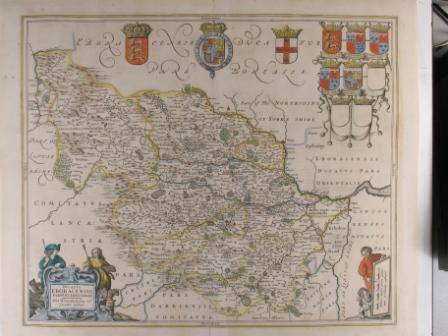
• Blaeu 1648 West Riding. C599/2. B2/41
• Photo of old road Blackstone Edge
• C762/3 Blackstone Edge letter G5
• Fairfax on Bramham moor or flight from Bradford? How they picked up men
• WYL100/PO/2/A/I/32 pass Mr. John Mattison and his servant to pass through co. York, addressed to officers under command of the Marquis of Newcastle. Signed J. Belasisse.
Events in Yorkshire in 1643 and 1644 had a critical effect on the outcome of the war. At the start of 1643, the Royalists controlled Yorkshire, but by the autumn of 1644 they had lost control of the North.
Sir Thomas Fairfax takes up the story.
Leeds, 23 January 1643
Leeds was garrisoned by 1500 royalists. “they visited us [Bradford] daily with their horse… Summoning the country [calling in volunteers] we made a body of about 12 or 1300 men with which we marched to Leeds and drew up within half cannon shot of their works…and sent in a trumpet with a sumons to deliver up the town to me for the use of King and parliament. …they returned this answer..that they would defend the town as best they could…the business was hotly disputed for almost 2 hours…the enemy were beaten from their barricades…[and] were forced open to the streets where horse and foot resolutely entering, the soldiers cast down their arms…the governor and chief officers swam the river and escaped…in all there were about 40 or 50 slain and a good store of ammunition taken which we had much want of.” Other accounts describe the battle taking place during a snowstorm.
Seacroft Moor, 30 March 1643
Towards the end of March 1643, Lord Ferdinando Fairfax, decided to consolidate his forces at Leeds. To cover his withdrawal from Selby, Sir Thomas Fairfax made a feint towards Tadcaster on 30 March. The Royalist garrison fled to York at Fairfax's approach, and Fairfax took the opportunity to dismantle Tadcaster's defences in order to make it untenable for the Royalists. The Earl of Newcastle reacted quickly and sent Lieutenant-General George Goring with twenty troops of horse and dragoons to recover the town. Goring arrived just as Fairfax's troops were marching away across Bramham Moor towards Leeds. Fairfax sent his infantry ahead with his cavalry acting as a rearguard.
“it troubled me much, the enemy being close upon us and a great plain to go over, so marching the foot in 2 divisions and the horse in the rear, the enemy followed about 2 musket shot from us…but yet made no attempt on us and thus we got well over this open country. But having again gotten to some little enclosures beyond which was another moor called Sea Croft Moor (much less than the first) here our men thinking themselves more secure were more careless in keeping order and while their officers were getting them out of the houses where they sought for drink (being an exceeding hot day) the enemy got… upon the moor. But when we had almost passed this plain also they… charged us both in flank and rear. The Countrymen [volunteers] …cast down their arms and fled and the foot soon after…some were slain and many taken prisoners. Few of our horse stood the charge. Some officers, with me, made our retreat with much difficulty…to Leeds. This was one of the greatest losses we ever received….I was sent to Bradford with 7 or 800 foot and 3 troops of horse. These two towns being all the garrisons we had.
At Wakefield, 6 miles off, lay 3000 of the enemy…”
• YAS, Battle of Wakefield
Wakefield, 20 May 1643
“[we were]… busied about releasing of the prisoners that were taken at Sea Croft Moor, most of them being countrymen whose wives and children were …importunate for their release…their continual cries tears and importunities compelled is to think of some way to redeem these men so we thought of attempting Wakefield (our intelligence being that the enemy had not above 8 or 900 men in the town). So upon Whitsunday [with 1100 foot and horse] we came before the town, but they had notice of our coming and had …set about 500 musketeers to line the hedges about the town…after two hours…the foot forced open a barricade where I entered with my own troop….we charged through and routed..after a hot encounter, some were slaine…my men…brought up a piece of ordnance and planted it in the churchyard against the body [of men] that stood in the market place who presently rendered themselves. All our men being got into the town, the streets were cleared. Many prisoners taken. …we saw our mistake now finding 3000 men in the town, not expecting half that number. We brought away 1400 prisoners …[and] we exchanged our men that were prisoners with these.
• SpSt/10/3/8 Image of siege of Chester 1645
• SpSt/10/3/3 order to Walter Stanhope to pay towards upkeep of Parl army 24 May 1643
Through [God’s] mercy we had held up near 2 years against a potent army, but they finding us now almost tired with continual service, treacherously used by friends and in want of many things necessary for support and defence, the Earl of Newcastle marched with an army of 10 or 12000 men to beseige us and resolved to sit down before Bradford which was a very untenable place….seeing it impossible to defend the town and with not above 10 or 12 days provision…we resolved the next morning very early with a party of 3000 men to attempt his whole army as they laid in their quarters 3 miles off.
Adwalton Moor, 30 June 1643 …when we were neare the place we intended, the enemy’s whole army was drawn up…we were to go up a hill to them which our forlorn hope gained by beating theirs into their main body which was drawn up half a mile further upon a place called Adderton Moor…ten or twelve troops of horse charged us in the right wing. We kept the enclosure, placing our musketeers in the hedges in the moor…the enemy [thought] of retreating…one Colonel Skirton, a wild and desperate man, desired his general to let him charge once more with a stand of pikes with which he broke in upon our men …and they…lost ground… the enemy bringing on fresh troops ours…began to flee and so were soon routed. The horse also charged us again. We not knowing what was done in the left wing, our men maintained their ground till a command came for us to retreat having scarce any way now to do it, the enemy being almost round about us and our way to Bradford cut off. But there was a lane in he field we were in, which as a happy providence brought us off without any great loss…the earl of Newcastle presently laid siege to the town[Bradford]. But before he had surrounded it I got in with those men I brought from Halifax. I found my father much troubled having neither a place of strength to defend…nor a garrison in Yorkshire to retreat to.
Bradford July 1643 …a messenger was sent from Hull to let him know he …should be readily and gladly received…my father having ordered me to stay [in Bradford] with 800 foot and 60 horse he intended that night for Leeds to secure it. Newcastle having spent 3 or 4 days in laying in his quarters about the town they brought down their cannon…the hills within half musket shot commanded all the town [and they] shot furiously upon us. Our little store was not above 25 or 30 barrels of powder at the beginning of the seige….we heard a great shooting of cannon and muskets. All ran presently to the works which the enemy was storming. Here for ¾ hour was very hot service but at length they retreated. They made a second attempt but were also beaten off. After this we had not above one barrel of powder and no match…so [we] resolved to draw off …before it was day…and to retreat to Leeds…. The foot ..was sent out through some narrow lanes…myself with some other officers went with the horse by an opener way…I must not forget to mention my wife who run as great hazards with us in this retreat… before I had gone 40 paces (the day beginning to break) I saw them upon the hill above us being about 300 horse. I with some 12 more charged them…the rest of our horse being close behind, the enemy fell on them …taking most of them prisoners; among them my wife (the soldier behind whom she was [riding] being taken). I saw this disaster but could give no relief …I stayed till I saw there was no more in my power to do but to be made a prisoner with them. Then I retired to Leeds…not many days after the Earl of Newcastle sent my wife back again in his coach with some horse to guard her …”
The war then moved on to Lincolnshire, Cheshire and Lancashire but in early summer 1644 Sir Thomas Fairfax was ordered back to Yorkshire where he and his father threatened York.
When the Earl of Newcastle marched north against the Scottish army in January 1644, he had left behind a small army of Yorkshire Royalists under the command of Colonel John Belasyse, the governor of York, who was ordered to defend against Parliamentarian incursions into Yorkshire and to ferry men and supplies northwards to the main army when required.
York called the Earl of Newcastle back to defend them which left the Scots free to march south to join up with the Fairfaxes, a total force of 22000 foot and 7000 horse. They besieged York.
Marston Moor, 2 July 1644
“soon after Prince Rupert came to relieve the town. We raised the seige and Hessay Moor being appointed the rendezvous the whole army drew thither; about a mile from where Prince Rupert lay, the river Ouse being between us which he, that night, passed over at Poppleton…being joined by the Earl of Newcastle’s forces made about 23 or 24000, but we something more…[we reolved] to march away to Tadcaster which made the enemy advance the faster…the place was Marston Fields…here we drew up our army.”
The Royalist army was defeated in what is described as the largest battle ever fought in England.
“Prince Rupert returned into the south, the Earl of Newcastle went beyond the seas with many of his officers. York presently surrendered and the North was now wholly reduced by the parliament’s forces, except some Garrisons”
One of these was Pontefract Castle.
The war caused a lot of hardship for local people.
• (Calderdale) MISC 331 copies of plague letters
• leeds PRs 1645
• SpSt/11/9/9 Leeds plague
• Birstall PRs?1643-4
• SpSt/14/2 Bradford Wool trade resumed 1644
“… and coming to Bradford I found some few people, but most of the inhabitants were scattered. I lodged in a cellar that night. And O! what a change was there made in the town in three days’ time! Nothing in the world left to eat or drink or lie upon! The streets were full of chaff, feathers and meal. The enemies having encamped near Bowling Hall and having emptied the town of what was worth carrying away… Joseph Lister [1643]
Pontefract 44, 45, 48
• Image of castle Wakefield Art Gallery
The first proper siege of Pontefract began on Christmas Day 1644. There were a large number of Royalist volunteers inside Pontefract Castle, including Nathaniel Drake of Godley near Halifax. He wrote a diary of the sieges.
On 1 March 1645 Sir Marmaduke Langdale in command of the Northern Horse came to Pontefract . There was a force of 6500 men besieging. Langdale’s horse scattered the parliamentarians and they drew back to Ferrybridge and Tadcaster.. The garrison sent out 200 musketeers to help and it was reported that the parliamentarians lost 300 dead and up to 800 taken prisoner. They also captured ammunition and guns. Langdale was then needed at Oxford. In his absence the parliamentarians returned and by 21 March the castle was back under siege.
Skirmishes and bombardment continued and the royalists broke out to capture supplies and cattle. The siege was really biting by May and Drake records that following a skirmish on 18th the royalist soldiers “ looked over the slaine men and … tooke of some of theire best loose garments as hattes and shoowes not forgetting their pockittes where they found some 10 groats, some 5s, some 10s … which gave them some encouragement in want of pay.” As well as arms and ammunition.
In June the fighting intensified and on 25 the parliamentarians took All Saints Church which had been a significant part of the castle’s defence. By July there were reports of plague in the town and on 21 July the royalists accepted the parliamentarians terms for their surrender. They could march away, without their arms. Some went to Newark to join the royalists there others returned home.
The royalists attempted to retake the castle in November 1646.
In 1646 Charles surrendered to Parliament, but in spring 1648 new royalist uprisings began.
On 3 June 1648 Colonel John Morris retook the castle by a trick, and imprisoned the parliamentarian garrison in the cellars.
• C1175 Account of Morris’ raid
Around 1200 Royalist supporters arrived to defend it over the next month. For the next few months the garrison were fairly free to capture supplies, in one raid capturing 300 cattle from Knottingley. They also used it as a base for raids as far away as Lincoln. However these raids resulted in some significant defeats and losses of men and a force of 5000 parliamentarians began to besiege the castle in September 1648. The royalist garrison was about 500 men and 60 horse. Initially the royalists continued to raid supplies each night. They also raided Doncaster intending to capture General Rainsborough who had been ordered north to take over the siege. He was killed in the attack. In early November Cromwell arrived to take control and the siege was tightened. Cromwell left on 4 December having ordered more troops and supplies to take the castle. He left Major General John Lambert in command.
• Image of castle siege works Birmingham Archives MS 1537/1
The siege continued even after the execution of the King on 30 January 1649. Heavy bombardment was still going on in March although discussions about surrender began in February. The parliamentarians offered honourable terms for all except 6 men including John Morris, the commander, who was regarded as the leader of the raid that killed Rainsborough.
On 18 March Morris and the other 5 attempted to escape . Morris and one other were successful, but were captured in Lancashire a week later. The castle finally surrendered on 24 March 1649, the last garrison in England to hold out against parliament in 1649. There were only about 140 men left of the 600 in November the year before. Morris was tried for the murder of Rainsborough and executed at York in August 1649.
• Terms of surrender? Lambert letter?
Immediately afterwards the people of Pontefract petitioned parliament for the castle to be demolished. They had suffered enough. Demolition began on 9 April with the Keep or Round Tower. Accounts suggest that the demolition was completed over the next two years.
• WYL119/6 image of castle after demolition
• QS1/8/6/16 petition of Isaac Watson of Pontefract re hardship [1669]
The end of the war
• WYL230/3871 copy of Charles’ death cert
2 of the signatories were Yorkshiremen, Sir John Bourchier of Beningbrough, and Sir Thomas Mauleverer of Allerton Mauleverer.
Afterwards
Pensions
• Tong 10/7 petition of Yorks soldiers for 3 years arrears of pay. 1654
• QS1/12/3/8/4 Lame soldiers quarterly pension roll 1672 B2.10
• QS1/11/1/6/1 petition of 11 old soldiers 1672
• WYL 230/3306 pardon to Wm Ingilby for all treasons 1662 (pretty)
• SpSt/11/5/6/5 Subversion – Parliament’s 10 commandments
• QS 1/7/1/2/5 Treasonous words against King 1667
Restoration
Categories: